
Form and Fold
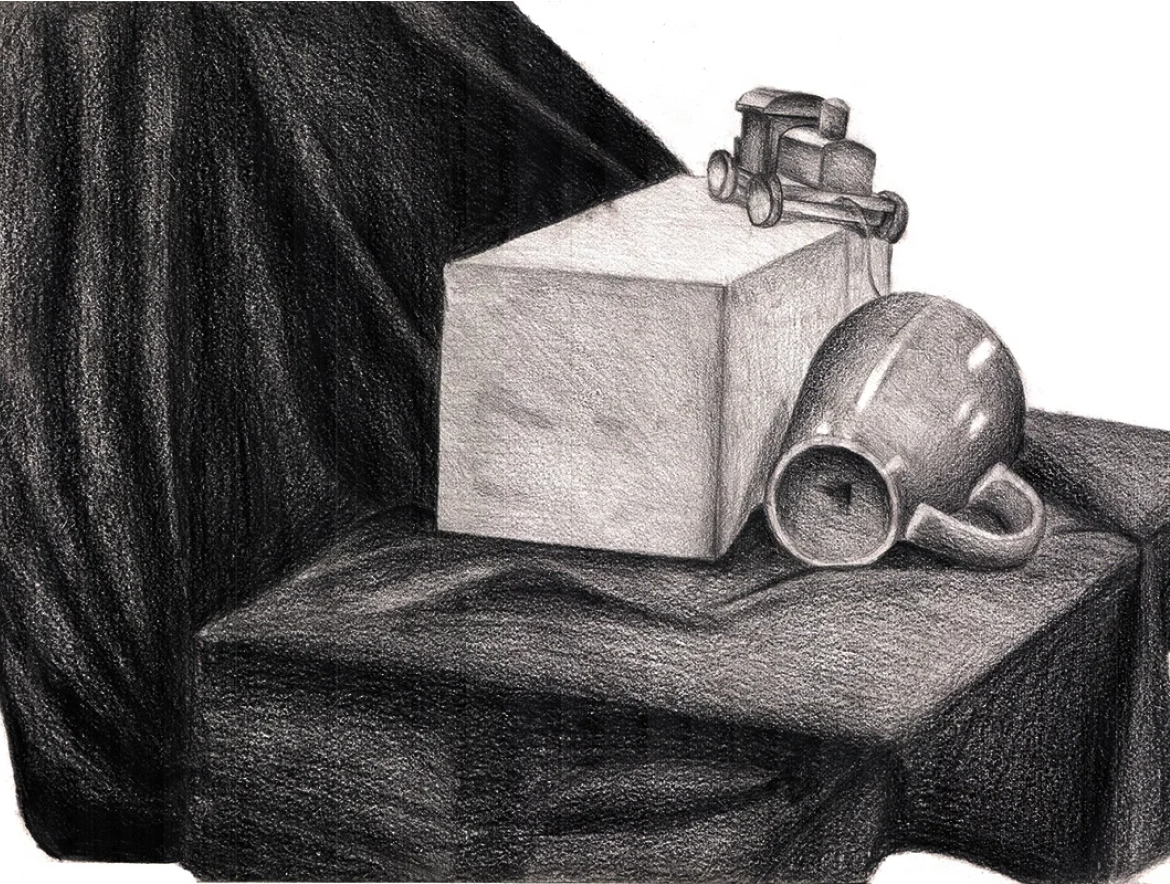
Artistic Description: A disciplined academic still life built around three deliberately contrasting forms, a hard-edged cube, a rounded ceramic mug, and a small toy tractor, arranged against heavy, deeply folded black drapery. The piece is entirely tonal, built through graphite shading alone, with no line work carrying the forms; instead, value shifts do all the work of describing geometry, reflection, and fabric weight. The drape's dense, near-black folds dominate the composition and push hard against the pale cube's flat planes, creating the strongest value contrast in the piece, while the mug's rounded, reflective surface, caught mid-tumble on its side offers a middle ground of soft gradients between the two extremes.
Authors's Message:
This piece is really about discipline more than subject matter three objects chosen specifically because they demand three completely different approaches to shading. A cube only needs flat planes and hard edges to read correctly. A mug demands smooth, continuous gradients to feel round and reflective. A small toy with awkward, layered details tests patience and precision at a much smaller scale. And underneath all of it, the black drape had to hold its own weight and folds without ever going muddy or flat, which took more restraint than almost
anything else on the page. Studies like this are not about making something beautiful they are about building the control that later lets beautiful things happen on
purpose.
Artist's Note
Value was built entirely through graphite pressure and layering no blending tools beyond the pencil itself, which keeps the tonal transitions honest and controllable. The drape's near-black folds required multiple passes of layered shading to reach that depth without losing the sense of fabric texture underneath, while the mug's highlights were preserved by leaving small, deliberate areas of paper untouched rather than erasing back into finished shading. Working across cube, cylinder, and irregular form in a single composition was the whole point a self-set exercise in translating very different surfaces using one consistent tonal language.